Blog

How To Extend The Life of North America’s Concrete Infrastructure

How To Extend The Life of North America’s Concrete Infrastructure

The United States requires a huge investment in all essential infrastructure, from railways and dams to bridges and airports. If the current network of highways remains in a state of disrepair, the consequences for the future could be serious.

One in ten bridges has been labeled as structurally deficient which means thousands of bridges in the US have considerable defects that requires rehabilitation. Concrete deterioration and a lack of safety features fail bridges to fulfill their intended purpose.

In Canada, one-third of the highway bridges have functional or structural deficiencies. The short remaining service life of concrete infrastructure is one of the biggest concerns for governments.

The civil engineering community is seeking solutions to reduce operating and maintenance costs of bridges during their service life. Fortunately, construction industries in Canada and in the US are now exploring advances in material sciences in order to meet public demands.

Companies like TUF-BAR are already developing innovative construction materials such as composite concrete reinforcement and fiberglass rebar. However, the construction industry in North America has been facing financial and technical barriers that make it difficult to explore or implement new construction technologies and products.

The whole life cost of a bridge is the sum of resources spent throughout the life of a bridge. From initial construction costs and repairs to maintenance costs, whole life cost of a bridge will help agencies make better decisions in the future.

Low life cycle cost is more important than low initial cost

Due to financial constraints, the construction industry is forced to choose relatively inexpensive construction materials such as steel or other traditional materials. If a country is serious about achieving sustainable infrastructure, it has to prioritize the whole life-cycle cost of a project. Using substandard materials might decrease the initial construction cost, but this will lead to high life-cycle costs and premature structural failures.

The significance of composite materials

It’s an established fact that corrosion of traditional materials is one of the reasons why concrete infrastructure deteriorates and needs expensive maintenance to reach its expected service life. On top of that, heavy traditional materials increase the indirect costs of rehabilitating a bridge. The use of composite materials like GFRP rebar is the only effective way to reduce the whole life cycle costs of critical concrete structures. Composite materials are inherently lightweight and offer twice the strength of traditional reinforcing materials. Low maintenance cost and the ability to construct long-life structures are two prime reasons why agencies in Canada and the United States should increasingly implement GFRP products.

About TUF-BAR

TUF-BAR produces and sells the highest quality GFRP fiberglass rebar and other fiberglass reinforcement products in North America. Our prime focus is to unlock sustainable construction possibilities. It’s time for you to build maintenance-free and durable concrete structures that can achieve service life of 100 years or more. Contact us for more information!

The Role Of Sustainable Concrete Infrastructure

The Role Of Sustainable Concrete Infrastructure

Concrete is one of the most enduring, economical, and fit-for-purpose building materials. It’s simply not possible to develop affordable and efficient infrastructure without concrete. A reasonable balance of economic, social, and environmental considerations is required to further enhance the usability and effectiveness of concrete.

Transportation of people and goods will become paralyzed without bridges, roads, port facilities, bus stops, and utilities. Concrete infrastructure helps remove and process waste, and provides the necessary supply of potable water. It enables the provision of education, health, and law-and-order.

Simply put, it’s critical to understand the role of concrete infrastructure in building modern civilizations. Concrete is the most essential material which helps sustain economic development. From dams, bridges, and processing plants to roads, LRT, and sewage lines, concrete is an economically viable building material required to build public structures.

What is sustainable concrete infrastructure?

Sustainability is often described as development that fulfills the needs of the present without affecting the ability of the next generation to meet their growing needs. When it comes to sustainable infrastructure, it must be developed and built with materials and construction processes that deliver desirable performance with respect to the environment, society, and the cost of the project over its full life cycle.

Sustainable infrastructure is supposed to be cost-effective, long-lasting, and ideal for the intended purpose. Concrete has the potential to help us achieve sustainability. It can meet future demands for necessary facilities while minimizing any bad environmental impacts.

Need for innovative construction materials

While concrete offers impeccable strength, it’s useless without reinforcement. The weak tensile strength of concrete makes it necessary to use a reinforcing material. Civil engineers have been using reinforcing bars to overcome this weakness. However, the corrosion of reinforcement creates new challenges. The global construction industry spends billions of dollars annually just to rehabilitate existing concrete structures. It’s not possible to achieve sustainability with construction materials that corrode and require regular maintenance.

Composite materials: an opportunity to achieve sustainable infrastructure

The importance of composite materials has increased over the past decade considering the need for maintenance-free and durable materials. Composite materials such as GFRP fiberglass rebar has what it takes to achieve long-lasting concrete structures. Unlike steel or other conventional materials, GFRP construction products don’t rust and provide superior tensile strength, flexibility, and ability to withstand harsh environments.

While maintenance-free and long-lasting concrete structures play a critical role in economic development, it’s time to encourage the use of composite materials to build structures that can maintain their integrity for a long period of time.

About TUF-BAR

TUF-BAR helps the construction industry in North America and around the world build sustainable concrete infrastructure with composite products such as GFRP fiberglass rebar, fiberglass rock bolts, dowels, and fencing panels. Contact us for more information!

How To Address Corrosion Of Wastewater Treatment Plants

How To Address Corrosion Of Wastewater Treatment Plants

Wastewater treatment facilities are subject to contaminants and moisture which create a highly toxic and corrosive environment for concrete and metal reinforcement. Aggressive environment causes premature deterioration and forces owners to perform expensive early repairs or replacements.

The harsh elements within a wastewater plant don’t show any respect for galvanized steel or aluminum which are often considered as corrosion resistant materials. When builders use steel or other traditional materials which are prone to corrosion, the only solution left is continued preventive maintenance to help a wastewater treatment facility reach its expected service life.

Corrosion of steel reinforcement is the main reason for most of the damage to steel-reinforced concrete structures. With more and more structures reaching a critical age, the annual cost of structural rehabilitation in Canada and across North America is in the billions. It’s more important than ever to develop and implement sustainable materials.

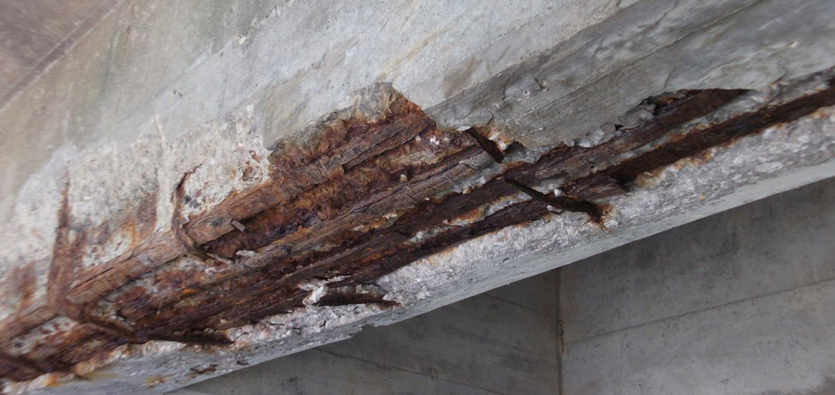
Since rust occupies more space than steel itself, it puts massive pressure on the concrete causing it to crack. With the passage of time, concrete spalling turns into serious structural deficiency, a situation where it becomes unsafe to use the structure. Concrete corrosion is started when the environmental elements penetrate concrete and reach the steel bars.

When it comes to the aggressive environment of wastewater treatment facilities, hydrogen sulfide is one of the common elements which causes corrosion-related problems and leads to expensive repairs. Premature failure of walkways, water tanks, railings, and other metal structures can be avoided with the help of composite materials such as GFRP reinforcement.

Glass fiber reinforced polymer (GFRP) rebar is an economically viable solution considering the high replacement costs, less reliability, and additional maintenance of steel-reinforced concrete elements. Instead of using short-term solutions to fight corrosion and lack of strength, governments can completely replace steel with composites in order to resolve the problem of structural deterioration permanently.

There’s no doubt about the fact that healthy concrete infrastructure saves time and money for both the government and taxpayers. The initial high cost of construction waterside buildings with GFRP rebar might not seem feasible. However, the use of GFRP composite materials has become inevitable considering the high maintenance costs. The maintenance-free properties of GFRP rebar and other products make it possible for structural engineers to build sustainable and maintenance-free water treatment facilities.

About TUF-BAR

North America is one of the largest producers and consumers of composite construction products, and TUF-BAR is one of the leading GFRP fiberglass rebar manufacturers. We manufacture and sell the highest-quality fiberglass rebar which is a stronger and lighter alternative to traditional steel reinforcement, an ideal material for building durable wastewater treatment facilities. Other ideal applications of our fiberglass rebar include bridge decks, roadways, marine structures, dams, concrete slabs, barrier walls, tunneling, and rail LRT. Contact us for more information!
Highlighting Major Issues With Reinforced Concrete

Highlighting Major Issues With Reinforced Concrete

There is no doubt about the fact that concrete itself a durable construction material which is used in many civil engineering applications. Nevertheless, concrete structures built in the last century are crumbling. Public infrastructure such as bridges, roads and buildings have been going through deterioration at an alarming pace. Many of the concrete structures developed in the first half of the 21st Century will go obsolete by the start of the next century.

Considering the extraordinary durability of some of the ancient structures like the Pyramid of Egypt and the Great Wall of China, it’s important to find out the reason behind the short service life of reinforced concrete. How come a structure built thousands of years ago is still standing firm and a bridge built with modern technology and materials is unable to survive even 50 years? There is something wrong with the modern concrete technology and it’s important to identify it in order to fix the problem.

Corrosion of concrete reinforcement

When it comes to identifying the potential factors which ruin the durability of concrete structures, the corrosion of steel reinforcement must be considered first. Steel is mainly made of iron and it’s inevitable to prevent the iron from rusting. When embedded steel reinforcement bars rust, this ultimately leads to concrete destruction which can be seen in the form of spalling and cracks.

The corrosion of steel reinforcement is hurting modern concrete infrastructure more than anything. Therefore, we need to permanently resolve the corrosion of reinforcement in order to build a sustainable future. Here are some of the notable reasons why concrete fails:

  • Corrosion of steel reinforcement
  • Improper design
  • Traffic growth
  • Extreme weather conditions
  • Regular wear and tear
  • Poor construction and maintenance practices

Solution

Various techniques have been developed to prevent steel from corroding. Stainless steel is an example of how steel can be empowered with some degree of corrosion-resistance. Unfortunately, these short-term solutions didn’t work out very well. The problem with steel is that we can slow down the corrosion process, but it’s not possible to make it completely corrosion-free. Therefore, it’s time to replace traditional concrete reinforcement materials with lighter, stronger, and corrosion-free materials. When it comes to properties like lightweight, corrosion-resistance, high strength, and electromagnetic neutrality, the best viable solution is composite materials, specifically GFRP reinforcement.

Related: The Application Of GFRP Reinforcement In New Construction

The growing and widespread use of GFRP is the only solution to permanently resolve long-standing problems such as steel corrosion and heavy maintenance costs.

About TUF-BAR

TUF-BAR has been striving to help the construction industry resolve problems such as lack of strength, corrosion, costly transportation, extended installation process, and short-term rehabilitation. Read the specifications of our GFRP rebar to understand how our composite products resolve these problems. Contact us for more information!
Exploring Alternative Materials To Reduce Corrosion Of Steel Reinforcement

Exploring Alternative Materials To Reduce Corrosion Of Steel Reinforcement

Exploring innovative construction materials such as composite GFRP creates new possibilities to enhance this technology and provide a better alternative than traditional materials in terms of cost, strength, and environmental concerns. Many nations are now realizing that composite materials like fiberglass rebar are the future of structural engineering. While it is tested and proven that GFRP materials are an excellent alternative to traditional materials, the construction industry in North America needs to make good use of these sustainable building materials both in new and rehabilitation applications.

High-resistance to corrosion and oxidation, rapid construction process, electromagnetic neutrality, relatively high mechanical properties and the ability to form complex shapes are some of the properties that nations need to build futuristic and maintenance-free concrete infrastructure.

In the last couple of decades, a great deal of research was carried out to identify new materials that can resolve structural problems which steel cannot. Corrosion of steel reinforcement is one of the biggest concerns; the United States and Canada spend billions of dollars every year just to repair existing concrete structures. Fortunately, composite materials have developed into promising concrete reinforcement products that can last for more than 100 years, outsmarting steel in many areas.

When public infrastructures such as highway bridges and waterside facilities are built with materials that can’t withstand tough environmental conditions, governments then have to spend plenty of resources every year to repair and maintain such structures. Since fiberglass rebar and other composite materials don’t require heavy maintenance, it isn’t wise to use traditional materials just because they’re slightly more inexpensive.

Taking into account the life cycle of a GFRP-reinforced structure, it is economically viable to use GFRP materials in order to avoid corrosion-induced deterioration, difficult and long construction processes, and costly maintenance. As mentioned earlier, direct corrosion cost is in the billions but it’s also important to consider the indirect costs such as traffic delays and user inconvenience.

As a long-lasting construction material, GFRP fiberglass rebar is designed to offer impeccable corrosion-resistance, extended service life, high strength, and ease of installation. Almost all the efforts made to study the in-practice performance of fiberglass rebar ended concluding that public and construction agencies should focus on replacing traditional materials with composites in order to ensure less burden on taxpayers and the environment in the future.

About TUF-BAR

At TUF-BAR, we produce fiberglass products using our proprietary patented pultrusion manufacturing process. We maintain strict control to ensure our products are in compliance with ACI and CSA building codes. Contact us for more information!

Growing Need For Sustainable Highway Infrastructure

Growing Need For Sustainable Highway Infrastructure

There is a growing need for the maintenance and repair of North America’s highway infrastructure. The deteriorated condition of aging bridges and roads create many financial challenges. Most of the old highway bridges in the United States were designed for a 50-year lifespan. The majority of these bridges were not built in accordance with the AASHTO Bridge Design Specification which calls for a 75-year lifespan.

The surface transportation network includes light rail trains (LRT), waterways, aviation terminals, bus transit systems, bridges, tunnels, and roads. Together or separately, these structures play a critical role in the efficient movement of goods and people around the United States and beyond.

Although America’s network of bridges and roads plays a key role in national growth, it hasn’t been properly maintained for decades. It is estimated that more than $170 billion of annual capital investment is required to resolve deteriorating conditions.

Bridge Decks

According to a recent report, more than 12% of all bridges in the United States are labeled as structurally deficient and over 13% are functionally obsolete. Bridge decks are more vulnerable to degradation due to their perpetual exposure to vehicular wheel loads and the aggressive environment. It has become critical to pay due attention to these bridges or the traveling public may face safety risks.

Deck failure doesn’t usually lead to any catastrophic results. However, deteriorating bridge decks must be rehabilitated or replaced immediately in order to avoid consequences. Considering the deficiencies with traditional materials, it has now become very important to study and implement sustainable, corrosion-free materials.

Role of composite materials in building sustainable concrete infrastructure

GFRP decks are modular systems which are strong yet inherently light. As compared to steel, composite bridge decks are easy to install; bridge rehabilitation can be done in a few days instead of months. As a corrosion-free material, composite bridge decks achieve longer service life than other types of traditional bridge decks. In addition, the quality of the finished product can be improved when manufactured in a factory environment where it is possible to accurately and frequently use strict ISO-9001 quality assurance criteria.

Well-planned highway infrastructure adds to the quality of life and puts less burden on taxpayers in the long run. The major concern is how to provide high serviceability and durable roads while preserving the environment.

About TUF-BAR

TUF-BAR is a leading manufacturer of composite construction products in North America. We strive to help the infrastructure community build long-lasting and maintenance-free concrete structures. Our GFRP fiberglass rebar is a lighter and stronger alternative to traditional steel. Lightweight, superior tensile strength and electromagnetic neutrality are the prime properties of our GFRP products which also have a life cycle of over 100 years. Browse through our website to learn more about our products.